2043 Views
US & Gulf nations to provide $300 Billion to rebuild iran, economic aid, repair Oil field, trade that benefit Iran if it leave its nuclear dream
Iran will rejects Trillions worth opprotunity, Iran Rapidly ramped Enriched Uranium, US & Gulf nations to provide $300 Billion to rebuild iran, economic aid, repair Oil field, trade that benefit Iran if it leave its nuclear dream.

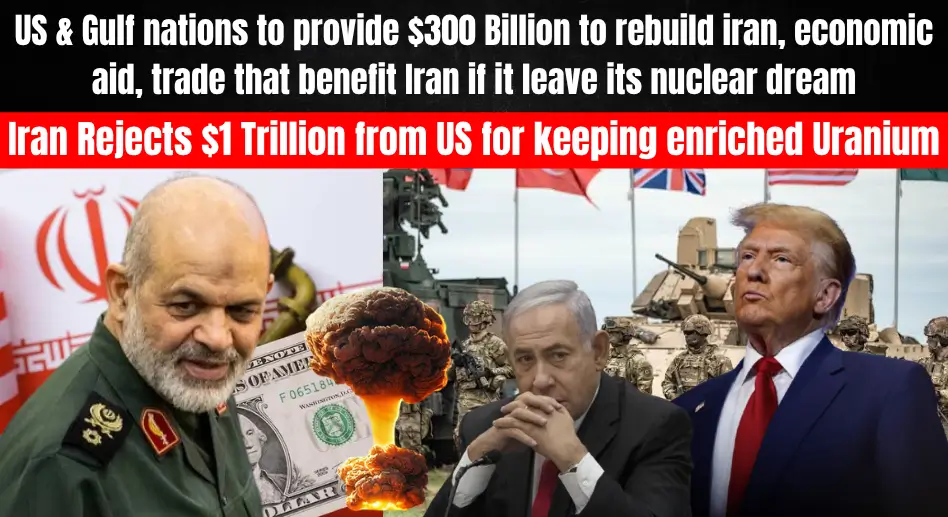

Recent reports indicate that large-scale trade in oil, gas, and economic sectors is set to take place between Iran, Arab nations, and the US, potentially pushing the total trade volume among them to as much as $1 trillion. Consequently, Iran has expressed its views regarding the Qatar talks with the US—while also laying down certain conditions—but has flatly refused to back down on the issue of nuclear enrichment. Iran believes that a US-Arab alliance—leveraging $500 billion in aid, frozen funds, and reconstruction packages—could pose a threat to its future. This is because the US and Israel want organizations like the IAEA to gain access to Iran to verify its existing uranium enrichment activities and secure a deal to have that uranium handed over to the US, thereby enabling them to coerce Iran into accepting their terms in the future.
Why Iran will reject $500 Billion US-Arab funds, US Sanctions lifted, Reopening of Hormuz to keep Enriched Uranium?
In the current context, it is understood that for Iran, enriched uranium—which represents the nation’s future—is more critical than the $500 billion in funding, the lifting of US sanctions, or normalization; this is because Iran is aware that the US and Israel employed similar tactics regarding Iraq, leading to years of warfare in both Iraq and Syria. Iranian intelligence is well aware that if Iran were to hand over its enriched uranium to Western nations—swayed by the US and Arab states—it might well be left with no means to threaten the US and Israel. In this context, Iran itself has acknowledged that—despite possessing missiles, drones, and intelligence capabilities—there are only two avenues that can protect it from an invasion by the US and Western nations: the Strait of Hormuz and nuclear enrichment. And if Iran falls for the US or Israel’s ploy—even by mistake—there is a possibility that it could face heavy bombardment from the US and Israel in the future.
Why Iran rapidly ramped up Uranium enrichment (to 60%+) as leverage after Trump withdraw from Obama’s JCPOA in 2015?
The 2015 JCPOA (Iran + US, UK, France, Germany, Russia, China) limited Iran’s enrichment to 3.67% in exchange for sanctions relief. After the US exit, Iran ramped up enrichment (to 60%+) as leverage. In 2025–2026 talks (often indirect via Oman/Qatar), Iran has rejected several US proposals while offering counteroffers. Negotiations have been on-and-off, complicated by military actions, with partial frameworks or ceasefires emerging at times but core issues unresolved. In short, Iran is open to a deal that respects its enrichment rights and delivers real economic gains with reliable guarantees — but rejects anything perceived as surrender or a repeat of the 2018 betrayal. Positions remain hardened on both sides. Recent reports indicate that the US, Israel, and many other nations had made concerted efforts to exert heavy pressure on Iran, aiming to secure a deal regarding uranium without resorting to future military conflict; however, the US and Israel were ultimately compelled to launch attacks on Iran, prompting retaliatory strikes by Iran against Arab nations. The US (under Trump) has pushed for no uranium enrichment on Iranian soil in any final deal, or at least a long suspension (10–20 years). Trump and officials have repeatedly stated the deal should not allow enrichment like the 2015 JCPOA (which capped it at 3.67%). Both Trump and Iran have their own respective constraints: Trump insists that Iran should not possess enriched uranium, while Iran maintains that without enrichment capabilities, its long-term existence would be at risk—potentially even leading to a regime change within the country.
The U.S. Forces are preparing to withdraw its military assets from RAF Akrotiri base and Diego Garcia after the RAF Fairford in the UK incidents
Russian forces preparing to launch pre-emptive strikes on NATO countries to disrupt NATO military Aid to Ukraine
Türkiye will raise interest rate and sell U.S. Treasury bonds to defend Turkish Lira, US Iran war, Ukraine War or Energy Crisis

US Army avoids the strikes on iranian nuclear sites, Iran may launch strikes on Israel or US bases, Does Iran has Nuclear weapons or Will Netanyahu fall?
Russia Agreed to send advanced fighter jets to North Korea amid rising US military influence in East Asia, and NATO losing influence in Africa

Chinese BiliBili Adopted Elon Musk’s Strategy over original Content, 1000 Followers, Free-Speech, and huge payouts, YouTube Vs BiliBili
Türkiye has deployed armed vehicles, tanks, Drones and Air Defenses in Southern Syria, Israel fears MECCA alliance?
Japan to produce $60 billion worth domestic Drones, Missiles, Ammunition and Aircraft amid growing risks from China, North Korea and Russia
Iran sold $1.75 billion worth of Shahed drones to Russia in exchange of more hypersonic missiles as US-Iran war escalating, NATO Vs Russian NAVY

NY Mayor Mamdani will brings $50 billion annual taxes from Corporate or Wealth Taxes on Billionaires
China plans to approve Russia’s mRNA Cancer Vaccine to halt $100 Billion worth of American Pharma imports
Top 5 countries agreed to pay $2 Million in Chinese Currency to Iran for Passes through the Strait of Hormuz
China’s exports reaches a record high $1 trillion despite the Trade war with US, Europe failed to defeat China
NATO nations betrayed Israel and the US for Russia’s new shipping and Economy corridor lanes in 2026
NVIDIA fears the loss of $1 trillion due to Foreign FDI moving into Huawei and OpenAI’s stakes
Mamdani will impose up to 5% taxes on $5 trillion wealthiest Pro-Israeli Jewish companies
Trump Tariff has earned $6 trillion in ‘withholding taxes’ in 2025, during the Tariff war against China, India, EU and Canada
African nations uniting against the US, UAE, NATO and Israel to protect Africa’s $25 trillion worth of Natural Resources
China will save Russia’s $1 trillion Economy during Ukraine war by signing a mutual investment pact : Russia GDP Collapsed?