
2879 Views
NY Mayor Mamdani will brings $50 billion annual taxes from Corporate or Wealth Taxes on Billionaires
Huge US Stock crash incoming?, Mamdani will affect Top 10 wealthiest people, ETFs, Stocks, Mutual Funds, Pension and Asset Management if he impose 12% Corporate or Wealth taxes on Billionaires of New Yorkers.

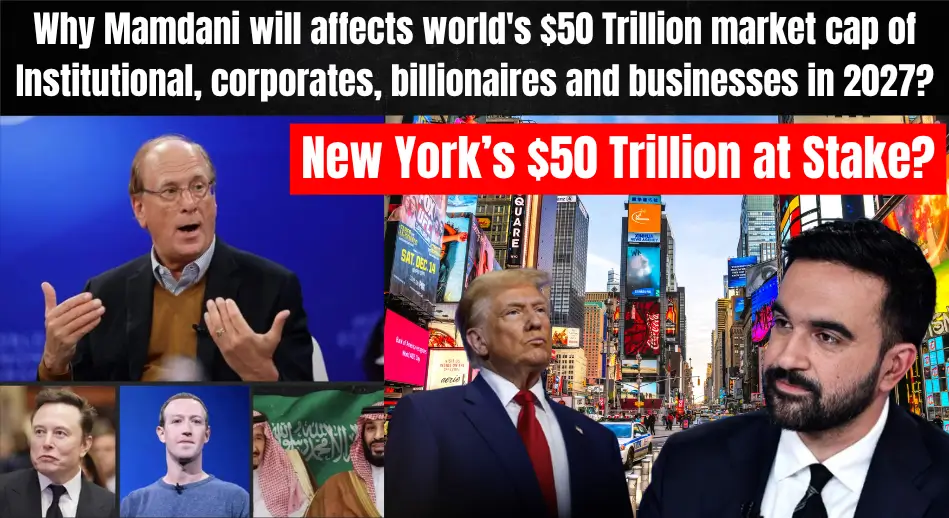

A recent report has revealed that numerous American influencers, corporate executives, businesspeople, wealthy individuals, and firm owners have made significant efforts to block corporate and wealth taxes in New York—thereby thwarting Mamdani’s tax proposals—but even billionaires, politicians, and major firms are unable to stop Mamdani, as he won the New York mayoral election precisely on the strength of this campaign. On one hand, there are those criticizing Mamdani to avoid wealth and corporate taxes; on the other, many New Yorkers view this move by him as a step toward a better future, as they are struggling with rising inflation, low-paying jobs, high crime (due to unemployments), poor transport services, and exorbitant healthcare costs in New York. While corporate and wealth taxes are already in place in New York—previously ranging from 5% to 7%—they could now rise to as much as 12%, potentially causing significant financial impact for the state’s wealthiest businesses, firms, and companies, as well as the top 10% of the wealthiest individuals.
Zohram Mamdani will increase upto 12% Corporate or Wealth Taxes on billionaires of New York.
The tax situation is complex; for instance, while earning $1 million annually in New York might require paying 2% of your revenue, earning $1 billion could mean paying up to 12%—a significant amount. On the other hand, New York faces a massive government debt, which hinders the state government’s ability to function effectively at the state level. However, with Mamdani’s proposed taxation plan, it is possible that New York could provide free healthcare, transport, and childcare, as well as improved infrastructure and public transit, alongside other essential government services.
How Mamdani will affects world’s $50 Trillion market cap of Institutional, corporates, billionaires and businesses in 2027?
Many people argue that by collecting corporate and wealth taxes, the administration is promoting socialism or communism; such measures could potentially be implemented in many US states, causing the greatest losses to BlackRock, US stock traders, companies, and firms. Given these factors, a major stake involving the world’s $50 trillion worth of stakeholders is now in play; New York leads the way globally in terms of top media outlets, assets under management (AUM), major companies, tourism, technology, Real Estate, healthcare and the financial sector, and is home to the highest number of billionaires.
NY Mayor Zohran Mamdani will affect global wealthiest people, ETFs, Stocks, Mutual Funds, Pension and Asset Management if he impose 12% Corporate or Wealth taxes on Billionaires of New Yorkers.
- Institutional Investors (asset managers, mutual funds, ETFs, pensions, insurers, etc.): ~60–80%+ (often the dominant category).
- Big 3 (Vanguard, BlackRock, State Street): Collectively the largest shareholder in ~88% of S&P 500 firms. They hold 15–25% on average per company (mostly via passive index funds/ETFs). Combined, they often represent a huge voting block. cambridge.org +1
- Other institutions (including investment advisors): Make up the rest of the institutional slice (e.g., ~38% for advisors in some breakdowns).
- Retail/Individual Investors (direct holdings): ~15–20% (or higher when including indirect via funds). Direct retail is smaller, but households overall (via retirement accounts, etc.) have significant exposure.
- Corporates / Nonfinancial Corporations (cross-holdings, strategic stakes, treasury shares): Low single digits (typically <5–10% aggregate). Corporations hold some stock in other firms, but this is not a major category for S&P 500 ownership compared to the broader market (~$3.3–3.6T total for nonfinancial corporates across all equities). Insiders/founders (a corporate-related category) hold notable stakes in some firms (e.g., tech giants).
- Foreign Investors: ~15–30% (varies by company; overall similar to broader US equity trends, with strong demand for S&P 500 names).
- Other (insiders, activists, governments, etc.): Smaller portions; insiders/families prominent in founder-led companies (e.g., Alphabet, Meta, Amazon).

The U.S. Forces are preparing to withdraw its military assets from RAF Akrotiri base and Diego Garcia after the RAF Fairford in the UK incidents

Russian forces preparing to launch pre-emptive strikes on NATO countries to disrupt NATO military Aid to Ukraine
Türkiye will raise interest rate and sell U.S. Treasury bonds to defend Turkish Lira, US Iran war, Ukraine War or Energy Crisis

US Army avoids the strikes on iranian nuclear sites, Iran may launch strikes on Israel or US bases, Does Iran has Nuclear weapons or Will Netanyahu fall?

Russia Agreed to send advanced fighter jets to North Korea amid rising US military influence in East Asia, and NATO losing influence in Africa

Chinese BiliBili Adopted Elon Musk’s Strategy over original Content, 1000 Followers, Free-Speech, and huge payouts, YouTube Vs BiliBili

Türkiye has deployed armed vehicles, tanks, Drones and Air Defenses in Southern Syria, Israel fears MECCA alliance?

Japan to produce $60 billion worth domestic Drones, Missiles, Ammunition and Aircraft amid growing risks from China, North Korea and Russia

Iran sold $1.75 billion worth of Shahed drones to Russia in exchange of more hypersonic missiles as US-Iran war escalating, NATO Vs Russian NAVY
NY Mayor Mamdani will brings $50 billion annual taxes from Corporate or Wealth Taxes on Billionaires
China plans to approve Russia’s mRNA Cancer Vaccine to halt $100 Billion worth of American Pharma imports
Top 5 countries agreed to pay $2 Million in Chinese Currency to Iran for Passes through the Strait of Hormuz
China’s exports reaches a record high $1 trillion despite the Trade war with US, Europe failed to defeat China

NATO nations betrayed Israel and the US for Russia’s new shipping and Economy corridor lanes in 2026

NVIDIA fears the loss of $1 trillion due to Foreign FDI moving into Huawei and OpenAI’s stakes
Mamdani will impose up to 5% taxes on $5 trillion wealthiest Pro-Israeli Jewish companies
Trump Tariff has earned $6 trillion in ‘withholding taxes’ in 2025, during the Tariff war against China, India, EU and Canada
African nations uniting against the US, UAE, NATO and Israel to protect Africa’s $25 trillion worth of Natural Resources
China will save Russia’s $1 trillion Economy during Ukraine war by signing a mutual investment pact : Russia GDP Collapsed?