
8024 Views
China’s largest bank has surpassed the $7 Trillion U.S. Federal Reserve, Dollar collapsing, US foreign Interest at stake
US Dollar and US Interest at Stake, EU, US, and Largest AUM accepting Yuan instead of USD and EUR, China’s Largest Bank has Surpassed the $7 Trillion U.S. Federal Reserve in 2027.

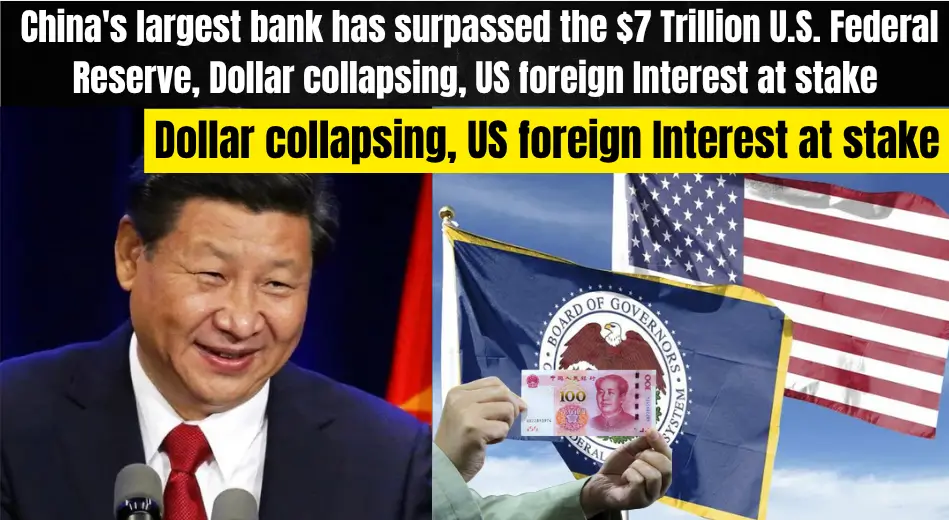

Recently it has been reported that some reports claim that now the People’s Bank of China is becoming the world’s largest central bank which can surpass the American Federal Reserve Bank in the coming few months due to which US Dollar, US Financial Assets, Investmnet firms and AUM (Assets Under management) may have to suffer huge losses. $6 Trillion People’s Bank of China will exceed U.S. Federal Reserve System by end of 2026. Chinese Central Bank could surpass $7 Trillion U.S. Federal and affect the Dollar dominance globally by 2027. China’s Industrial and Commercial Bank of China (ICBC), its largest commercial bank, has indeed grown its balance sheet to around $7.3–7.6 trillion in USD terms as of mid-to-late 2025 data (with some reports citing figures above $7 trillion by early 2026). ICBC is a massive state-influenced commercial bank focused on domestic lending in China. Its assets include huge volumes of loans to Chinese businesses and households, plus investments. Chinese banks like ICBC, Agricultural Bank of China, and others dominate global rankings by raw asset size due to China’s scale, high domestic savings rate, and state-directed credit growth.
US Foreign Interest and “At Stake” Claims
China has reduced its direct holdings of US Treasuries over years—from peaks over $1.3 trillion to around $693 billion as of February 2026 (third-largest foreign holder after Japan and the UK).
Total foreign holdings of US Treasuries have actually risen to record levels near $9.5 trillion, with other buyers (including US domestic investors and other nations) stepping in.
- This diversification reflects normal risk management, not a coordinated attack on the dollar. China has incentives to hold dollar assets for trade and reserves stability.
- A sudden large dump would raise US yields (increasing borrowing costs) but also devalue China’s remaining holdings and strengthen the yuan (hurting exporters). It’s a mutual assured disruption scenario.
- Broader “US foreign interest at stake” often ties into de-dollarization efforts (e.g., BRICS, yuan trade settlement), but progress has been incremental. The dollar’s share in global reserves and payments has declined slowly, not collapsed.
China’s banking system faces its own challenges: high local government debt, property sector issues, and state-directed lending that can create inefficiencies or non-performing loans—despite massive scale.
Top EU, US and largest AUM accepting Chinese Yuan to settle billions worth payments, and international trades.
The Chinese Yuan (RMB/CNY) is not a major global reserve currency, but its use in official government and financial sectors has grown modestly through bilateral trade settlements, central bank swap lines, and limited reserve holdings. No major central bank has shifted away from the USD or euro as primary reserve assets to fully “accept” the yuan as a dominant holding—its global allocated reserve share stands at only about 1.95–2.2% as of late 2025/early 2026 (per IMF COFER data). top EU institutions, US entities, and largest global asset managers (by AUM) that accept or facilitate Chinese Yuan (RMB/CNY) for settling billions-worth payments and international trade.
ECB (via PBOC swap line): The ECB maintains a bilateral euro-RMB currency swap arrangement (extended to October 2028) with a maximum size of CNY 350 billion (~€45 billion). This serves as a backstop liquidity facility to address potential RMB shortages at euro-area banks, supporting large bilateral trade and investment volumes between the EU and China. It enables indirect facilitation of RMB settlements for euro-area financial institutions but is not used for routine “acceptance” as a core reserve asset.
Major EU banks and clearing centers:
- HSBC (strong European presence) and other global banks with EU operations participate in CIPS and act as offshore RMB clearing banks (e.g., in London, Frankfurt, Paris, Luxembourg).
- Frankfurt (Germany) is a designated RMB clearing center, reflecting Germany’s role as China’s top EU trading partner. Luxembourg leads in RMB securities settlement in Europe.
- Large euro-area banks (e.g., Deutsche Bank, BNP Paribas, Société Générale) handle RMB trade settlements for corporate clients in goods trade, often in the billions annually through correspondent banking or CIPS. Chinese state banks like ICBC, Bank of China, and CCB report handling trillions in RMB cross-border settlements, with European branches involved in EU-China trade flows.
Overall EU engagement is driven by trade volumes (China is a major partner) rather than broad adoption. No full shift away from euro/USD for core government/financial sector payments.
The world’s largest asset managers—BlackRock, Vanguard, State Street (often topping $10+ trillion AUM combined in recent years)—primarily manage investments in RMB-denominated Chinese assets (e.g., bonds via Bond Connect, stocks via Stock Connect, or panda bonds) rather than “accepting” yuan for settling external payments or trades on behalf of clients.

The U.S. Forces are preparing to withdraw its military assets from RAF Akrotiri base and Diego Garcia after the RAF Fairford in the UK incidents

Russian forces preparing to launch pre-emptive strikes on NATO countries to disrupt NATO military Aid to Ukraine
Türkiye will raise interest rate and sell U.S. Treasury bonds to defend Turkish Lira, US Iran war, Ukraine War or Energy Crisis

US Army avoids the strikes on iranian nuclear sites, Iran may launch strikes on Israel or US bases, Does Iran has Nuclear weapons or Will Netanyahu fall?

Russia Agreed to send advanced fighter jets to North Korea amid rising US military influence in East Asia, and NATO losing influence in Africa

Chinese BiliBili Adopted Elon Musk’s Strategy over original Content, 1000 Followers, Free-Speech, and huge payouts, YouTube Vs BiliBili

Türkiye has deployed armed vehicles, tanks, Drones and Air Defenses in Southern Syria, Israel fears MECCA alliance?

Japan to produce $60 billion worth domestic Drones, Missiles, Ammunition and Aircraft amid growing risks from China, North Korea and Russia

Iran sold $1.75 billion worth of Shahed drones to Russia in exchange of more hypersonic missiles as US-Iran war escalating, NATO Vs Russian NAVY

NY Mayor Mamdani will brings $50 billion annual taxes from Corporate or Wealth Taxes on Billionaires

China plans to approve Russia’s mRNA Cancer Vaccine to halt $100 Billion worth of American Pharma imports
Top 5 countries agreed to pay $2 Million in Chinese Currency to Iran for Passes through the Strait of Hormuz
China’s exports reaches a record high $1 trillion despite the Trade war with US, Europe failed to defeat China

NATO nations betrayed Israel and the US for Russia’s new shipping and Economy corridor lanes in 2026

NVIDIA fears the loss of $1 trillion due to Foreign FDI moving into Huawei and OpenAI’s stakes

Mamdani will impose up to 5% taxes on $5 trillion wealthiest Pro-Israeli Jewish companies
Trump Tariff has earned $6 trillion in ‘withholding taxes’ in 2025, during the Tariff war against China, India, EU and Canada
African nations uniting against the US, UAE, NATO and Israel to protect Africa’s $25 trillion worth of Natural Resources
China will save Russia’s $1 trillion Economy during Ukraine war by signing a mutual investment pact : Russia GDP Collapsed?