6799 Views
G20 nation buying record-high GOLD, Silver and Metals amid thier Currency collapsing rapidly, $25 Trillions at Stake in US Market?
World’s largest Currency collapsed, BRICS currency, Trump Xi Jinping meeting in Beijing, US-Iran war, Nuclear war, G20 countries are buying Gold, Silver and Metals to fight global energy, financial and economic crisis.

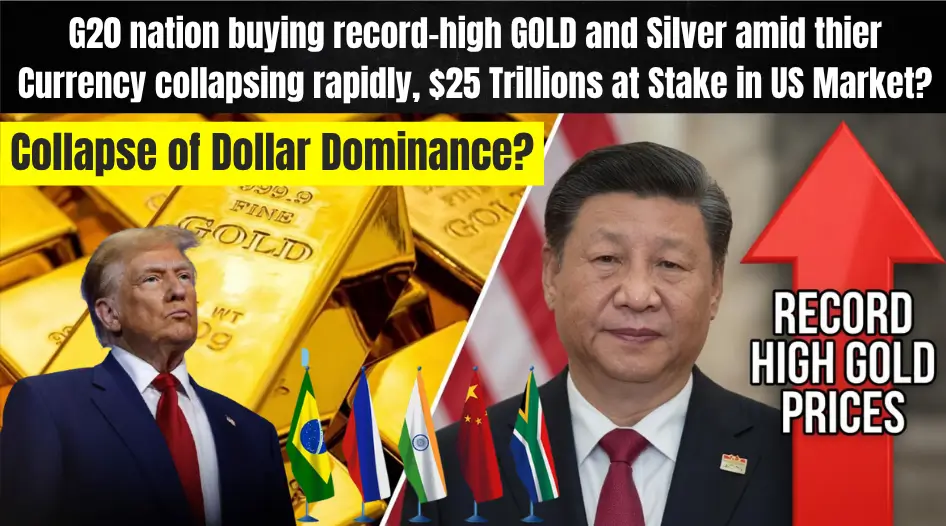

Recently a report has revealed that the local governments of the world are now buying record-high Gold, Silver and Metals because it is being said that all the currencies and Forex pairs along with the Dollar are now buying Gold due to Trump Tariff, Iran War, crude, Ukraine War, and Financial Crisis and are telling their people not to buy Gold for now so that their local governments can be saved from the economic crisis. Because it is being said that countries across the world have suffered economic losses due to the Iran-US war. It is being said that in the future, the dominance of the dollar can fall by 40% and come under the Chinese Yuan. BlackRock, JP Morgan and Elon Musk had also said about the collapse of the petro-dollar because they feel that if the US still does not pay attention to its foreign interests, then China, Russia and BRICS can establish a dollar alternative currency within the world.
Why Strait of Hormuz, Iran war, Ukraine War, and spike in Gold prices could damage US dollar dominance and US interest?
Because it has been told that even Iran is not ready to bow down on the Strait of Hormuz, due to which the Chinese economy, currency, and China Bond are getting record-high profits and dominance and Trump also knows very well that if Iran acquires nuclear weapons, then China, Russia, and Europeans will again join hands with the Arab world and will cause huge damage to the US dominance in Europe, Africa, Middle East and East Asia. China has been reducing reliance on USD assets (global dollar share in reserves has declined from 72% in 2001 to ~58% recently). Reports explicitly link its gold accumulation to declining dollar reserves and a strategic shift toward “hard assets” for the next monetary phase. Its total forex reserves remain massive ($3.4 trillion+), but the composition is diversifying away from dollars.
Why Multiple Central banks of G20 Countries are buying Gold and Metals instead of US Dollar and US treasury bonds?
Now it has been said that if countries like China, India, Japan use Yuan-for-Oil in the coming days after coming under pressure from Iran, China and Russia, then there will be major losses for America in US Debt, US Dollar Dominance, US interest, and US banking systems and US Treasury Bonds. Central banks of G20 countries (surveys show 43% plan more gold) view it as a hedge against dollar dominance erosion, sanctions risks, inflation, and geopolitical fragmentation. Gold has hit repeated record highs (thousands per ounce), with silver also surging on industrial + safe-haven demand. US says, it has $10 trillion+ annual foreign trades with Dollar through SWIFT and payment systems. China and Russia are currently building world’s second largest Worldwide Interbank Financial Telecommunication.
China is a dominant player in physical metals markets, with strong investment and industrial demand for silver (e.g., via ETFs and bullion). More than 100+ central bank interest in silver as a monetary asset is emerging (e.g., some reports of positions or discussions), though gold dominates official reserves. China’s industrial demand for base metals remains high. China’s Treasury sales/diversification tie into broader concerns about ~$25T in additional US debt projected over the next decade (debt held by public already >100% GDP). This is part of a multi-year BRICS+ trend (China, India, Russia, Brazil) where gold now makes up a larger share of reserves (~17%+ for the bloc). US economic experts says, China, Russia and other BRICS countries are buying record-high GOLD, Silver and Metals to backing their own local and Euro-Styled BRICS (Currency) currencies to reduce US dollar Forex Reserve and US treasury bonds.

The U.S. Forces are preparing to withdraw its military assets from RAF Akrotiri base and Diego Garcia after the RAF Fairford in the UK incidents
Russian forces preparing to launch pre-emptive strikes on NATO countries to disrupt NATO military Aid to Ukraine
Türkiye will raise interest rate and sell U.S. Treasury bonds to defend Turkish Lira, US Iran war, Ukraine War or Energy Crisis

US Army avoids the strikes on iranian nuclear sites, Iran may launch strikes on Israel or US bases, Does Iran has Nuclear weapons or Will Netanyahu fall?
Russia Agreed to send advanced fighter jets to North Korea amid rising US military influence in East Asia, and NATO losing influence in Africa

Chinese BiliBili Adopted Elon Musk’s Strategy over original Content, 1000 Followers, Free-Speech, and huge payouts, YouTube Vs BiliBili
Türkiye has deployed armed vehicles, tanks, Drones and Air Defenses in Southern Syria, Israel fears MECCA alliance?
Japan to produce $60 billion worth domestic Drones, Missiles, Ammunition and Aircraft amid growing risks from China, North Korea and Russia
Iran sold $1.75 billion worth of Shahed drones to Russia in exchange of more hypersonic missiles as US-Iran war escalating, NATO Vs Russian NAVY
NY Mayor Mamdani will brings $50 billion annual taxes from Corporate or Wealth Taxes on Billionaires
China plans to approve Russia’s mRNA Cancer Vaccine to halt $100 Billion worth of American Pharma imports
Top 5 countries agreed to pay $2 Million in Chinese Currency to Iran for Passes through the Strait of Hormuz
China’s exports reaches a record high $1 trillion despite the Trade war with US, Europe failed to defeat China
NATO nations betrayed Israel and the US for Russia’s new shipping and Economy corridor lanes in 2026
NVIDIA fears the loss of $1 trillion due to Foreign FDI moving into Huawei and OpenAI’s stakes
Mamdani will impose up to 5% taxes on $5 trillion wealthiest Pro-Israeli Jewish companies
Trump Tariff has earned $6 trillion in ‘withholding taxes’ in 2025, during the Tariff war against China, India, EU and Canada
African nations uniting against the US, UAE, NATO and Israel to protect Africa’s $25 trillion worth of Natural Resources
China will save Russia’s $1 trillion Economy during Ukraine war by signing a mutual investment pact : Russia GDP Collapsed?